


Floor markings are the silent infrastructure of a safe industrial site. They separate pedestrians from forklifts, define keep‑clear zones around machinery, and guide traffic through aisles that change shape every shift. Yet the moment that paint fades, tape peels, or a pallet stack is moved, those boundaries stop existing. A laser light line projector solves that reliability problem by drawing the line with light instead of ink - a boundary that is always present, always the correct width, and always exactly where your risk assessment says it should be.
What Is a Laser Light Line Projector and How Does Virtual Line Marking Work?
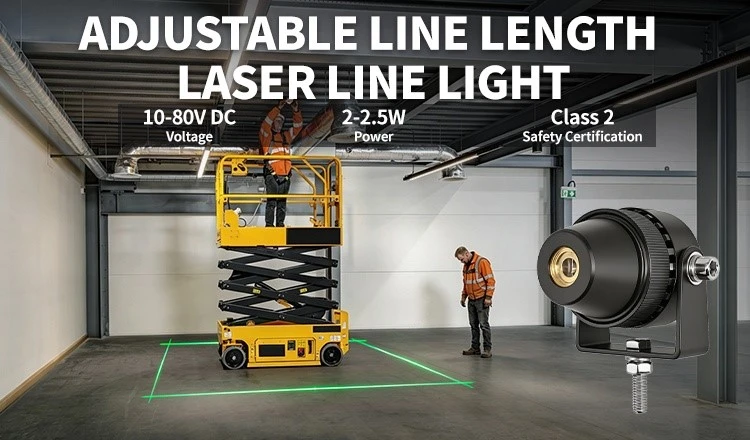
A laser light line projector is an opto‑electronic fixture that uses a high‑power laser diode combined with a precision line‑generating optic to cast a visible, continuous line onto a working surface. Instead of applying material to the floor, the device projects a virtual line from a mounted housing - typically to the ceiling, a rack upright, a pillar, or a machine frame - and that line becomes the operative boundary for traffic, storage, or alignment.
The optical principle is straightforward but demanding. A cylindrical lens, a Powell lens, or a diffractive element spreads the collimated laser beam into a fan of light; the fan intersects the floor plane as a bright stripe. Because the divergence is fixed by the optic, the projected line widens predictably with mounting height, which is why a laser light line projector can be specified precisely for a given installation geometry rather than guessed at. A well‑engineered unit holds its line width, edge sharpness and colour consistency across its full working distance - the quality that separates a genuine industrial instrument from a decorative gadget.
Unlike paint, a laser light line projector has no consumables and no wear surface. There is nothing for a forklift wheel to scrub away, nothing for a scrubber‑dryer to dissolve, and nothing that needs re‑stencilling after a rack layout change. When a zone boundary moves, you re‑aim the fixture instead of calling a contractor.
Core Benefits of Replacing Paint and Floor Tape With a Laser Light Line Projector
The business case for virtual marking rests on three pillars: durability, flexibility, and behavioural effect.
Durability first. Conventional floor paint in a busy distribution centre degrades quickly - abrasion from pallet trucks, chemical attack from cleaning agents, and simple UV bleaching all take a toll. Within months, a crisp safety line becomes a faint line. A laser light line projector removes that maintenance cycle entirely, because the marking exists only as light and never as a substrate. Fixtures with a 50,000‑hour LED‑class diode lifespan and sealed industrial housings routinely deliver years of uninterrupted service.
Flexibility second. Warehouse layouts are never static. Seasonality, new product lines, and re‑slotting all move the boundaries. Tape and paint force a shut‑down and a re‑marking project; a laser light line projector can be re‑positioned, re‑angled, or switched to a different pattern during a single maintenance window. Multi‑pattern models even allow a single fixture to display a solid boundary during normal operation and a flashing alert during a changeover.
Behavioural effect third - and this is the one safety managers underestimate. A static painted line becomes visual wallpaper; experienced operators stop registering it. A projected line sits on the floor plane at eye level in the driver's forward field of view, and when it pulses or changes colour it re‑captures attention at exactly the moment it matters. That is why sites that install a laser light line projector frequently report stronger compliance than sites relying on paint alone.
Key Factors That Determine the Visibility and Accuracy of Laser Line Projection
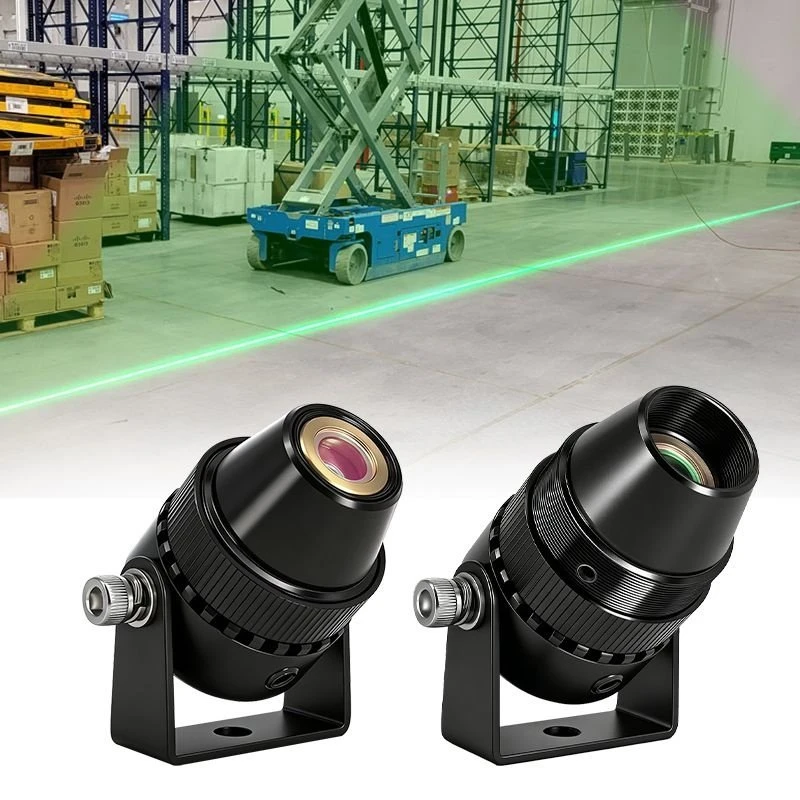
Specifying a laser light line projector is an engineering exercise, not a catalogue pick. Four variables dominate real‑world performance.
Ambient illuminance. A projected line must out‑compete the light already falling on the floor. Dim night‑shift conditions need only modest output; modern LED‑lit warehouses with high‑bay luminaires demand substantially more. Direct sunlight intruding through open dock doors is the hardest case of all, and the practical answer is usually physical shielding - a baffle or curtain - rather than brute‑force brightness.
Surface characteristics. Polished power‑floated concrete reflects specularly and can wash out contrast, while dark, matte, rubber‑coated flooring absorbs light and demands a higher radiant intensity for the same perceived brightness. Dust films on lenses act as a slow dimmer switch, which makes scheduled lens cleaning part of the specification rather than an afterthought.
Colour and wavelength. Amber‑yellow is the default for general caution because human peripheral vision is most sensitive to it under mixed indoor lighting; red is reserved for stop conditions and immediate hazard; green signals a safe‑to‑proceed state. Consistency of colour across the fleet matters as much as the choice itself - operators should never have to interpret two fixtures differently.
Geometry. Mounting height, tilt angle, and the intercept theorem all govern how wide the stripe becomes and how much energy is spread across each square centimetre. Raise a laser light line projector and the line grows longer and dimmer; that trade‑off is physics, not a product defect, and it must be resolved on paper before the fixture is ordered. Sighting obstructions - rack uprights, stacked pallets, mezzanine columns - then decide whether one central unit or several distributed units are needed.
Top Industrial Applications of Laser Light Line Projector in Warehouses and Factories
Pedestrian–forklift separation is the highest‑value application. Intersections, crosswalk approaches, and blind corners are where near‑misses accumulate, and a projected boundary combined with a flashing alert gives both parties an unambiguous signal to stop, yield, or re‑route.
Loading docks come second. Dock‑edge risk combines moving vehicles, reversing trailers, restricted visibility and compressed timing. A laser light line projector mounted above the bay can mark the safe stand‑clear band on the floor and switch to an alert state when a vehicle is manoeuvring.
Machine status transition is a third, less obvious use. Automated conveyors, palletisers and robot cells restart on schedule or on sensor trigger, often without warning to anyone standing nearby. A projector that changes from steady to flashing communicates a state change in the one place a worker is already looking.
Beyond safety, alignment duties are common: cutting tables, folding stations, panel saws and CNC loading areas all benefit from a projected reference line that replaces chalk, tape and time‑consuming manual squaring. The same hardware, specified with a tighter optic and a finer line width, serves precision positioning rather than traffic control.
Critical Installation Rules for Stable, Reliable Laser Virtual Safety Markings
Vibration is the first enemy. A fixture bolted to a working mezzanine or a conveyor frame will drift out of alignment within weeks; mounting to a structural member with an isolator or a rigid bracket solves it. Aim for a mount that a technician can adjust without scaffolding.
Second, design for service access. Lenses need cleaning, brackets need re‑aiming after layout changes, and cabling needs inspection. A laser light line projector installed in a position nobody can reach safely will be neglected, and a neglected projector is indistinguishable from a broken one.
Third, verify the line on the floor rather than on the drawing. Walk the projected boundary at both shift lighting levels, stand where a real operator stands, and confirm the line is legible at the distance where the decision actually gets made. Pilot the installation on one intersection before committing to a facility‑wide rollout.
Laser Safety Classes, IP Ratings and Compliance Requirements for Industrial Use
Industrial laser projectors for line marking normally fall into Class 1, Class 2, or Class 3R under IEC 60825‑1, depending on accessible emission at the aperture. Class 1 and Class 2 units are suitable for unrestricted placement in occupied areas; higher classes require controlled access, warning signage, and trained personnel. Any credible supplier should be able to provide the classification, the accessible emission data, and the conformity documentation for each model.
Environmental protection is equally non‑negotiable. Warehouses combine dust, humidity swings, washdown chemicals, and impact from handling equipment, so an IP65 or IP66 housing plus a meaningful IK impact rating is the realistic minimum. Add temperature range and EMC considerations, and confirm the power supply is rated for your site voltage and any local machinery‑directive requirements.
Laser Light Line Projector vs Traditional Marking Solutions: Limitations and Trade‑Offs
Honest comparison matters more than advocacy. Paint and tape have real strengths: they are visible in full sunlight, they need no electrical infrastructure, and their installed cost is low at small scale. Nothing about a laser light line projector removes the need for conventional signage as a redundant layer.
The genuine limitations are physical. A projected line can be interrupted by an object standing in the beam. It reads less clearly on reflective or wet surfaces. It requires power and, in a wide facility, a coordinated control strategy so that fixtures behave consistently. It also demands a competent installation, because a poorly aimed projector is worse than no projector - it teaches operators to distrust the signal.
Weighed against those constraints, the trade is usually favourable where marking must survive daily abuse, where zones change frequently, or where a visual alert must fire at a specific moment. In those conditions, a laser light line projector is not a novelty upgrade; it is the lowest‑maintenance way to keep a safety boundary permanently in force.


