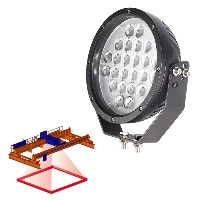
Warehouse pedestrian-forklift collision remains one of the most frequent and severe workplace hazards in modern logistics and manufacturing facilities. Statistical data from the National Safety Council shows 84 forklift-related fatalities occurred in the United States in 2024, and 36% of these fatal incidents involved pedestrians struck by moving industrial trucks. Traditional painted floor markings wear away quickly under heavy wheel traffic, and static safety signs fail to deliver dynamic alerts when forklifts turn, reverse or operate in dim aisles. Laser Area Warning Lights serve as an active visual safety solution that projects clear virtual danger zones on the floor, bridging the visibility gap between vehicle operators and on-site workers. This guide systematically introduces the working principle, performance specifications, selection criteria, installation requirements and compliance notes of laser area warning lights, helping warehouse managers make data-driven procurement decisions to lower accident rates and meet occupational safety regulations.

What Are Laser Area Warning Lights and How Do They Work
Laser Area Warning Lights are industrial-grade optical safety fixtures mounted on forklifts, reach trucks, AGVs and overhead cranes, designed to project sharp, visible laser lines or boundary zones onto the ground to mark hazardous operating ranges. Unlike passive painted lines, these lights move synchronously with industrial vehicles, so the warning boundary shifts in real time as the forklift travels, reverses or steers.
After rigorous laboratory and field testing, our laser area warning lights adopt Class 3R laser modules that comply with IEC laser safety classification, delivering stable projection without permanent eye damage risk for nearby staff. The rugged aluminum alloy housing provides reliable protection, and certified units reach IP67 waterproof and dustproof rating, which means they can withstand splashing water, fine dust and continuous vibration in busy warehouse environments. The fixtures support a wide DC voltage range of 9–80V, compatible with nearly all types of powered industrial trucks used in distribution centers and production plants, with a rated service life exceeding 50,000 hours under normal operating conditions.
Warehouse teams commonly deploy red laser zones behind forklifts for reverse warning, blue laser lines on side blind spots, and green projected lanes for safe pedestrian passage. The high contrast laser beam stays distinguishable even under mixed indoor lighting, which solves the common pain point that faded floor paint cannot remind workers in low-light corners.
Core Benefits of Deploying Laser Area Warning Lights in Warehouse Operations
The most measurable advantage of Laser Area Warning Lights is collision risk reduction. Field tracking data from industrial safety projects shows facilities that install calibrated laser zone warning systems can cut pedestrian-vehicle near-miss events by up to 60% within three months after deployment. This improvement comes from the early visual cue: pedestrians can spot the glowing boundary before the forklift enters their line of sight, especially in rack blind spots, narrow aisles and loading docks.
Laser area warning lights also reduce long-term maintenance expenditure compared with traditional floor marking. Epoxy paint and adhesive safety tapes require repainting every 3–6 months in high-traffic zones, consuming labor and halting partial warehouse operations. Laser projection creates a virtual marking that does not contact the floor surface, so there is no abrasion, peeling or frequent rework. For 24/7 multi-shift warehouses, the low-maintenance design delivers stable safety performance and cuts recurring safety marking costs.
Additionally, these warning lights simplify safety compliance audits. OSHA inspectors focus on effective separation between pedestrians and powered industrial equipment. When paired with operator training and pedestrian traffic rules, laser area warning lights form tangible evidence of proactive hazard control, helping sites reduce OSHA citation risks during routine audits.
Key Technical Specifications to Evaluate Before Purchase
When comparing suppliers, warehouse managers should verify a set of core parameters to match laser area warning lights to their on-site conditions. First, laser safety class is non-negotiable. Class 2 and Class 3R are the acceptable grades for warehouse pedestrian warning; higher-power laser classes carry eye injury risks and are not suitable for continuous open-area use.
Housing protection grade is the second critical factor. IP67-rated units resist dust ingress and temporary water spray, fitting general warehouses, cold storage and covered loading zones. If your facility regularly cleans floors with high-pressure water jets, selecting IP68-rated models will deliver longer service life. Operating temperature range is equally important. Our laser area warning lights operate stably from -45°C to 85°C, adapting to cold-chain warehouses, hot metal fabrication workshops and outdoor yard operations.
Projection adjustability directly affects practical effect. Premium products support adjustable beam angle and projection distance, so safety officers can customize the warning zone size: a narrow 1-meter buffer zone for very tight aisles, and a 3-meter wide danger boundary for heavy-lift forklifts with large turning radii. The available beam patterns include single side lines, U-shaped rear danger zones and arrow guidance marks, which buyers can select according to their internal traffic layout. Voltage compatibility must be checked carefully, as mismatched voltage will burn out modules and cause unexpected safety failures.
Compliance and Certification Requirements for Global Warehouse Buyers
For North American, European and Australian warehouse operators, valid certification documents are mandatory before introducing Laser Area Warning Lights. CE certification covering LVD and EMC directives is required for sales and operation within the European Economic Area. Products should also follow ISO 9001 quality management standards to guarantee consistent batch performance.
Buyers serving regulated markets should confirm that suppliers provide test reports demonstrating laser radiation safety, vibration resistance and waterproof performance. Many procurement teams overlook documentation and only check light brightness; uncertified laser lights may fail inspection, or worse, emit out-of-spec laser energy that creates new occupational hazards.
We provide OEM and ODM service for laser area warning lights. We can adjust laser color, bracket style, mounting method and cable length according to customer site specifications, and supply full certification packages to support the buyer's local safety audit and tender documentation.
Installation Guidance and Best Practices
Correct installation determines whether laser area warning lights reach expected safety outcomes. Technicians usually mount the fixtures on the top rear or side guard of forklifts, using sturdy steel brackets or magnetic quick-mount bases. The installation height should be calibrated so the projected zone lands on the ground 1–2 meters away from the vehicle body, avoiding light projection onto racks or pedestrian eye level.
After installation, safety managers need to hold a short briefing for both forklift operators and walking staff. Workers must learn that the laser boundary marks the danger zone, not a guarantee that the driver has seen them. Laser Area Warning Lights are an auxiliary alert system, not a replacement for mirrors, backup alarms and pedestrian traffic protocols.
Regular inspection routines should be added to the daily forklift checklist. Operators need to check whether laser lines are blurred, flickering or misaligned before starting shifts. Shock from cargo collisions can shift the bracket and distort the projected warning zone, so timely adjustment prevents false sense of security.
Common Mistakes to Avoid During Procurement
One widespread mistake is overemphasizing laser brightness while ignoring laser safety rating. Extremely bright laser beams may appear more noticeable, yet they can exceed safe radiation limits and trigger eye injury risks. Another error is purchasing one-size-fits-all lights without considering aisle width and forklift type. A wide U-shaped laser zone designed for container handlers will block pedestrian paths in narrow rack aisles and cause workflow disruption.
Some buyers treat laser area warning lights as a one-time fix for all safety problems. It is important to clarify that they work best as part of a layered safety system combining signage, aisle separation, training and speed limits. Facilities that rely only on laser projection without traffic rules still face collision risks.
Conclusion
Laser Area Warning Lights represent a practical, cost-effective upgrade for warehouse pedestrian-forklift safety systems. With verifiable accident reduction data, durable industrial construction and flexible customization, they solve the core weakness of static floor markings in dynamic material handling environments. For warehouse managers, the procurement process should balance laser safety classification, IP rating, voltage compatibility, certification and on-site layout. When selected, installed and managed properly, these lights protect staff, reduce downtime and help sites maintain long-term regulatory compliance. If you need customized laser zone patterns or bulk quotation for your warehouse fleet, contact our engineering team for tailored safety lighting solutions.